2024 – Election Misinformation
As communication patterns are changing rapidly, citizens have more sources of information from which to choose. Recent research shows that amid this multiplicity of sources, citizens are increasingly using those which tend to confirm their prior or existing attitudes and beliefs, rather than engaging with a range of alternative views (Iyengar & Hahn, 2009; Stroud, 2010). This is one reason social media has become a natural place to obtain and share news. As people increasingly consume the news through social media this results in widespread diffusion of misinformation (Silverman & Singer-Vine, 2016; Budak et al., 2011). This summer’s cohort focused on emerging misinformation detection using a combination of candidate conversation, survey responses, newspaper articles, social media posts, and search trends in the summer leading up to the 2024 Presidential elections. Students developed and compared different learning models, starting with models used in previous elections.
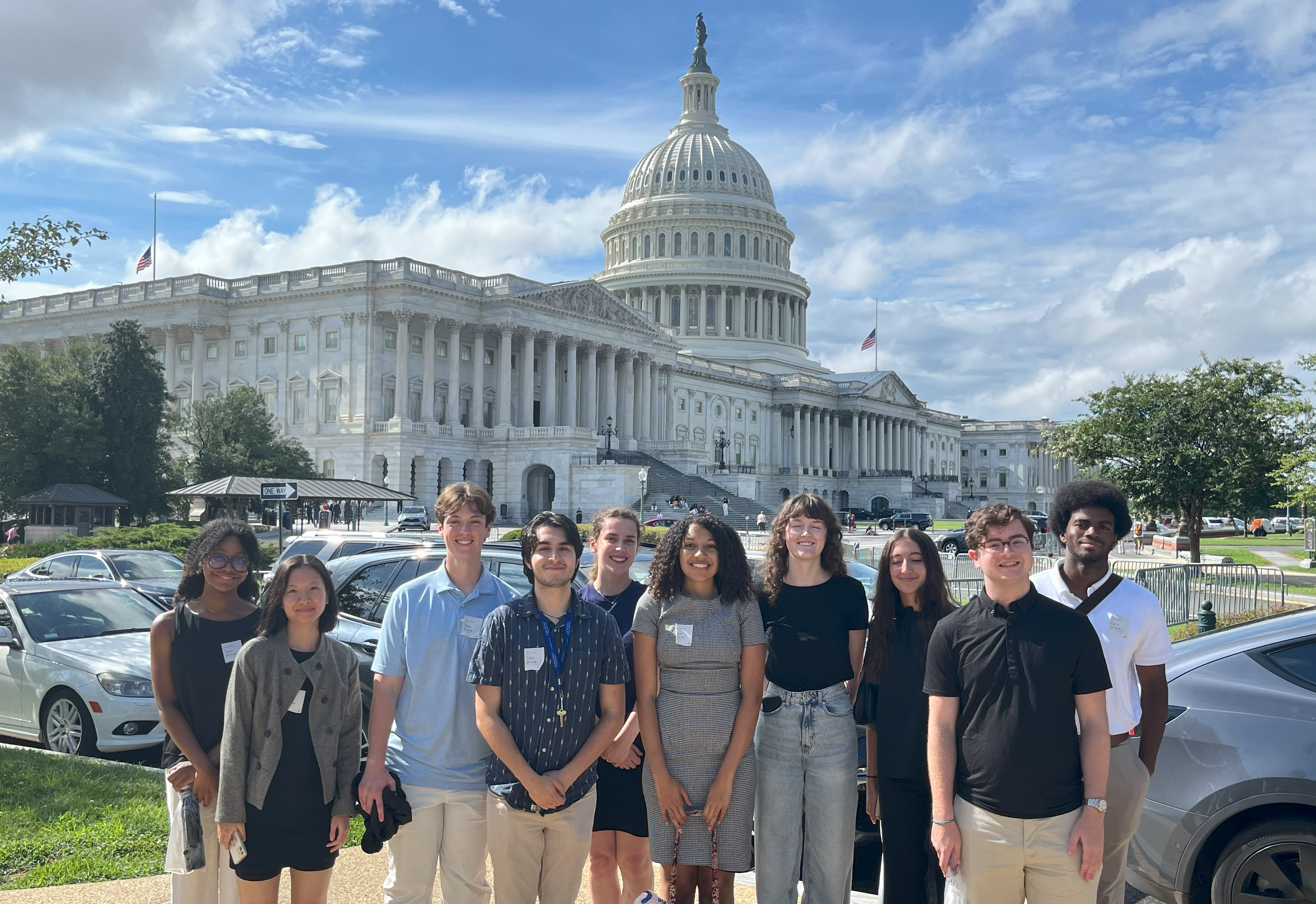
10 students from across the country worked in three groups, each focusing on a different social media platform: Twitter/X, YouTube, and Reddit. Students worked together in groups, received lectures from interdisciplinary faculty, went on field trips around the DC area, and finally presented their work in a meeting with industry and at a poster presentation on Georgetown’s campus. A subset of these students continued their work into the fall semester to co-author a paper about their findings.
Cohort
Jahir Bakari
University of Maryland Baltimore County ’25
Pleasant Ballenger
University of North Carolina at Chapel Hill ’25
Claire Chou
University of Illinois at Urbana Champaign ’25
Diego DiMattina
University of Virginia Main Campus ’25
Kenedy Ducheine
University of South Florida Main Campus ’25
Aiden Ehrenreich
Georgetown University ’26
Caroline Field
High Point University ’25
Kylie Griffiths
University of Oregon ’25
Lucy Olander
Georgetown University ’26
Katie Wilson
Smith College ’26
